
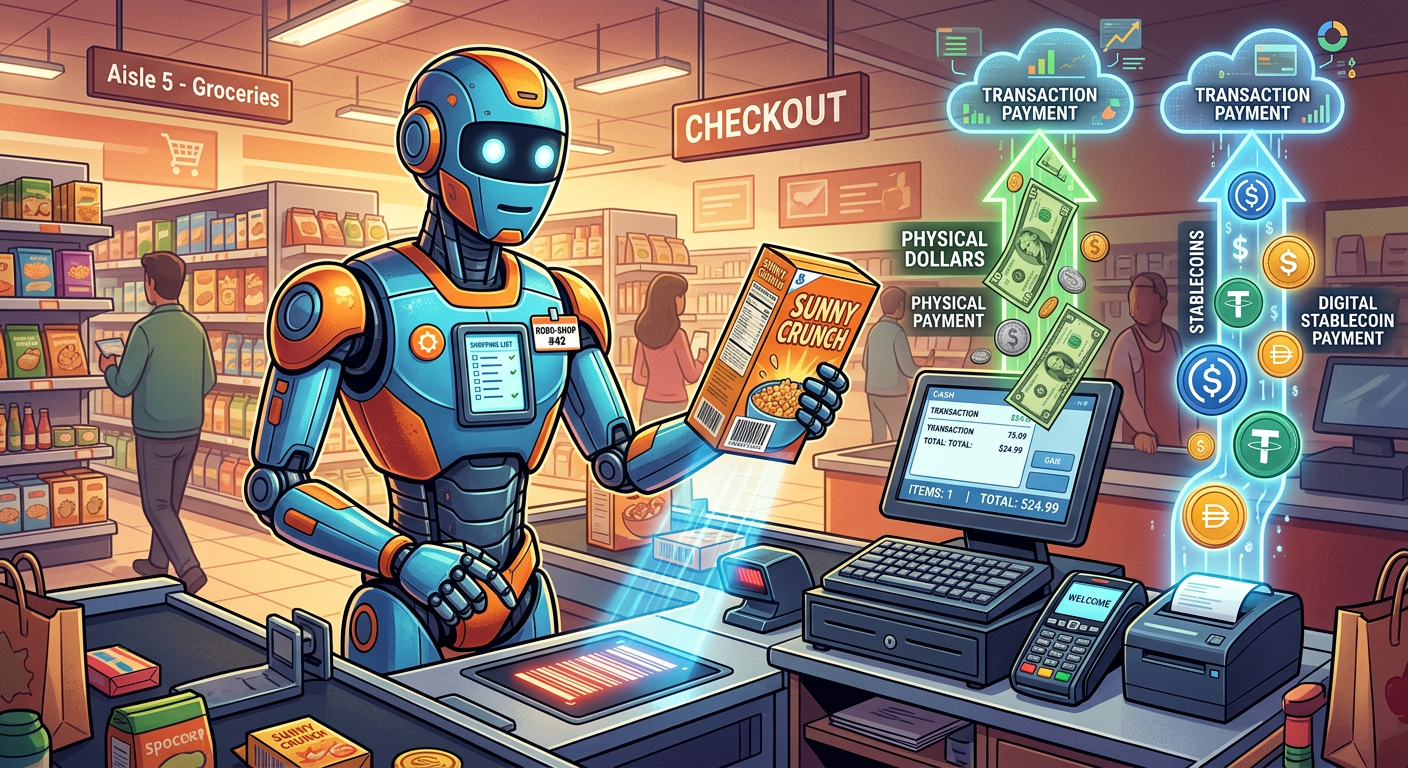
The card networks and the crypto firms are no longer fighting over the same agentic checkout payments market. They are quietly dividing it. By mid-2026, the production landscape has settled into a pattern: AI agents authorize and settle retail consumer purchases on card rails, and machine-to-machine and cross-border B2B flows increasingly settle on stablecoins. The split is not ideological. It tracks who carries the loss when an agent gets a purchase wrong.
The infrastructure arrived in pairs. Mastercard launched Agent Pay and Visa announced Intelligent Commerce within a day of each other in April 2025, both wrapping agent transactions in tokenization and cryptographic mandates. Both then joined Google’s AP2 mandate scheme in September. On the other rail, Coinbase’s x402 protocol lets an agent pay a server in USDC over plain HTTP, with V2 live since December 2025, Stripe integrating it on Base in February and Cloudflare adding support.
Liability decides the agentic checkout rail
The reason the rails are diverging is that the two transaction types have different answers to one question: when an agent buys the wrong thing, who eats it. Retail consumer commerce has a built-in answer that took fifty years to construct. Card networks carry chargebacks, dispute resolution and issuer liability, so a consumer whose agent over-orders has a path to a refund. That machinery is the product, and it is why Visa and Mastercard are positioned to keep agent-driven retail on cards.
Machine-to-machine commerce has no such inheritance. When one agent pays another for compute, data or an API call thousands of times an hour, chargebacks are not just unnecessary, they are unworkable; you cannot run a dispute process on a sub-cent payment that completes in milliseconds. What those flows need is finality, low cost and speed, which is what a stablecoin settling over HTTP provides. Mastercard’s own June 2026 launch of Agent Pay for Machines, aimed at high-frequency low-value transactions, is a tacit admission that the card model does not fit this end of the market without rebuilding.
The contested middle of agentic checkout is cross-border B2B
So the agentic checkout map looks stable: cards hold consumer retail, stablecoins take machine and B2B. But the boundary is where the contest moves next. Cross-border B2B is the contested middle, large enough to want dispute protection yet international enough to suffer from card economics and settlement lag. That is exactly the flow stablecoins can pull onto their rail if a liability framework for token payments matures, and exactly the flow the networks will fight to keep by extending their guarantees outward.
Visa is hedging accordingly, supporting USDC and EURC settlement so a transaction can authorize on its rails and settle in a stablecoin where that makes sense. That is the networks acknowledging they may not own the settlement layer for every flow, only the authorization and dispute layer. It is a smaller, more durable position than owning the whole transaction, and it is the one the liability question pushes them toward.
The numbers behind the split are starting to show. On the stablecoin side, x402’s traction came fast once the pieces lined up: Stripe wiring it into Base, Cloudflare supporting it at the edge, and a growing set of agents paying for APIs and compute in USDC by default. On the card side, the networks are racing to ship agent authorization at parity, because every retail purchase an agent makes is a transaction they intend to keep. Neither side is taking the other’s territory. They are fortifying their own and circling the cross-border B2B middle, which is the only flow genuinely up for grabs.
For anyone building an agentic-commerce product, the practical guidance is to stop asking which rail wins and start asking what the transaction needs. A consumer-facing agent buying physical goods belongs on cards, because the buyer will eventually want a refund. A backend agent paying for tokens of compute belongs on a stablecoin, because no one is filing a dispute over a fraction of a cent. The two-rail outcome is not a transitional mess on the way to one winner. It is the steady state the liability of each flow was always going to produce.